


Miklat Moments
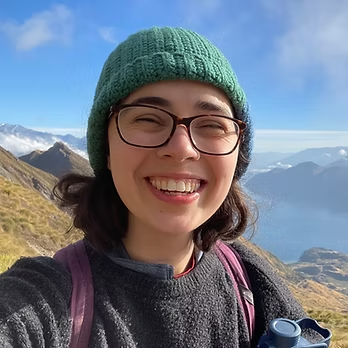
This blog post was written by Galya Fischer, a 2025/26 Yahel Social Change Fellow in Haifa.
Today marks the 30th day since the beginning of the war with Iran. In some ways, it feels much longer - we’d been anticipating conflict weeks before, go-bags packed and ready, waiting for the penny to drop. By the time the first siren sounded (and certainly by the fourteenth that day), it was unmistakable. Now, a month later, we are well-acquainted with the conflict and all its little details. We know the difference between miklats, mamads, and migunits; we can tell between Hezbollah and Iranian missiles; and we can certainly differentiate between a big boom and a small boom. We’ve also grown to recognize the different types of alerts: the budumbudumbudum of a pre-missile warning, the tling tling, tling tling of a real siren, accompanied by the classic ouiiiiiiiiiiiii, and finally, the awaited chikachikhaaa of an all-clear signal releasing us from the shelter.

When people think of war, we often think grand. We see sweeping scenes of disaster, immense suffering, and military might. The ugliness and pain of war is real and important to address. But all the death doesn’t capture the life that people continue to experience - the smaller, quieter moments, the makeshift routines created, and the experiences that bring people together. In this blog post, I want to center on these little moments of real intimacy and community found in unexpected places. Of course, I can only draw from my own personal experiences, which are admittedly less fraught than those of many others living across the land and region. I don’t intend to make light of the real suffering many people are experiencing, most of all those who don’t have the privilege of access to shelters. But it is precisely during challenging times when I find it all the more important to slow down and practice the art of noticing. By appreciating the beauty within (not so) ordinary moments*, we find humor and meaning that uplifts and brings us together.
Since February 28th, I’ve experienced 101 sirens indicating a missile or drone attack, not to mention countless hatraot, or preliminary alerts. (And yes, I keep track - it’s oddly satisfying.) By now, it’s routine. With each siren, we rush to the closest shelter, hunker down through the booms, and wait for a release signal. Across these 101 times, I’ve found refuge in different spaces: my grandmother’s apartment in Herzliya, our Kiryat Haim apartments up north, Eilat hotels down south, an airbnb in Tel Aviv, and, in extreme cases, on the side of the road outside. And within each place, I’ve come to notice and deeply appreciate both the moments of togetherness and the delightfully absurd.
In mamads, or private residential protected spaces, I’ve shared inside jokes, delightful memes, and time with friends and family. Whether it’s 3am or 3pm, we keep each other company, melting into cuddle piles on one bed, playing games, singing songs, and even performing shadow puppet theater. These moments are comfortable and private; they keep us close, literally and figuratively. But mamads aren’t the spaces I’ve come to think about most.

Oddly enough, it is the miklat I’ve come to appreciate. These public shelters are scattered across the country, beneath apartments, schools, office buildings, or random structures. Within miklats, people of all walks of life squeeze together into one space. In Tel Aviv, I’ve come across people sleeping on mattresses underground, while a man caught mid-run jogged around in circles. I’ve spotted QR codes for singles in bomb shelters while dogs looking strikingly like their owners playfully wrestled. In Lod, I met an old Russian lady who shared candy from her pockets while a pair of religious men roused others in song. In Netanya, I crammed into a tiny room in the back of a gas station with nine others, surrounded by a lifetime supply of bamba, cigarettes, and wine.
And in Kiryat Haim, I’ve been slowly and finally getting to know my neighbors. In my friends’ apartment, an Ethiopian family and Russian-speaking family, both with the most adorable toddlers, banter to pass the time. In my own apartment building, an 8-year-old boy sits on a small lawn chair, checking missile updates on one phone and playing Roblox on another. Sometimes in pajamas, sometimes mid-Passover clean, and sometimes barely conscious, I’ve shared small moments with these people. (And, just as important, I’ve bonded with a family’s dog, who dutifully comes for scritches every siren.)

Each miklat holds its own unique personality, formed both by the space itself and the individuals who happen to fill it in a given moment. With every siren, different constellations of people emerge, dissipate, and reform. And within these spontaneous and temporary communities, I see the challenges I face reflected in the other strangers sitting alongside me. That gives me strength.
And that’s where I find the real magic. Within miklats, I see people who would never otherwise meet thrown together into the same moment. Sometimes it may be an awkward silence, other times lively conversation, and still other times may involve loud singing, candies, and dogs, but it’s always shared. Certainly, these times are not without tension - people argue about when to leave, flinch at loud booms, or discuss the latest strike. But they do so together.
In difficult times such as these, I think it’s strangely beautiful - seeing strangers coming together and sharing a moment of uncertainty. Out of these reluctant moments, emerge comfort, tension, and awkward care. And so, despite our nearly six months of being here volunteering on the ground, I feel more connected to people and communities here when I’m in a miklat than ever before. Despite the lack of sleep, the uncertainty and instability ever-present in our lives, and the real fear and danger of the war, I know I’ll look back on these little shelter moments and smile.
*see Ordinary Affects by anthropologist Kathleen Stewart, an excellent book about the art of noticing the ordinary as extraordinary.


Comments