


Nurturing Linguistic Diversity in Haifa

Updated: Jul 12
This blog post was writen by Cecilia Bachana, a 2025/26 Fellow in Haifa.
Language in Israel has often been the center of debate. Even since the first few waves of immigration to the British Mandate, Israel and the Jewish people in the land have grappled with the challenge of balancing the centrality of Hebrew as the Jewish language with the linguistic diversity of the Jewish diaspora. On one hand, the revival of Hebrew as a modern spoken language by Mendele Mokher Soferim, Eliezer Ben-Yehuda, and others is an admirable feat of a people reclaiming its indigenous identity. At the same time, in the effort to unify all the “new Jews” under the banner of the budding State of Israel, diaspora languages like Yiddish were actively suppressed.
Still, for decades, Israel had two official languages, Hebrew and Arabic, until the 2018 Nation-State Law established Hebrew as the sole official language and demoted Arabic to “special status.” Today, approximately 50% of people in Israel speak Hebrew as their native or primary language, 20% speak Arabic, 15% speak Russian, 2% Yiddish, 2% French, 1.5% Amharic, and 7.5% other languages such as Spanish, Romanian, Thai, or Ladino. Street signs are written in Hebrew, Arabic, and English, and public transportation announcements are made in all three languages.

While language-based discrimination and conflict still exist, in some places linguistic suppression has given way to acknowledgement, and perhaps even to embrace. This possibility shines in Haifa, the city that I have called home for the last eight months during my time as a Yahel Social Change Fellow. Despite growing up in New York City, which has the highest linguistic diversity in the world, I have never been more struck by intentional linguistic inclusion that I am at Horim BaMercaz, a center for young families in Haifa where I volunteer with Yahel. There, diversity of background isn't just a word; it's a practice.
I volunteer at a program that is modeled like Kindergarten, where parents bring their young children to play, engage in circle time, sing, and eat together. One Monday morning in January, our program coordinator Keren led us in a Hebrew children's song that involved counting to three and clapping between verses. After the first round in Hebrew, Keren said, “Now in Russian!”, and we sang the entire song again, led by the Russian-speaking mothers. We cycled through the song twice more after that, in Spanish–guided by a Spanish-speaking family–and then in English.
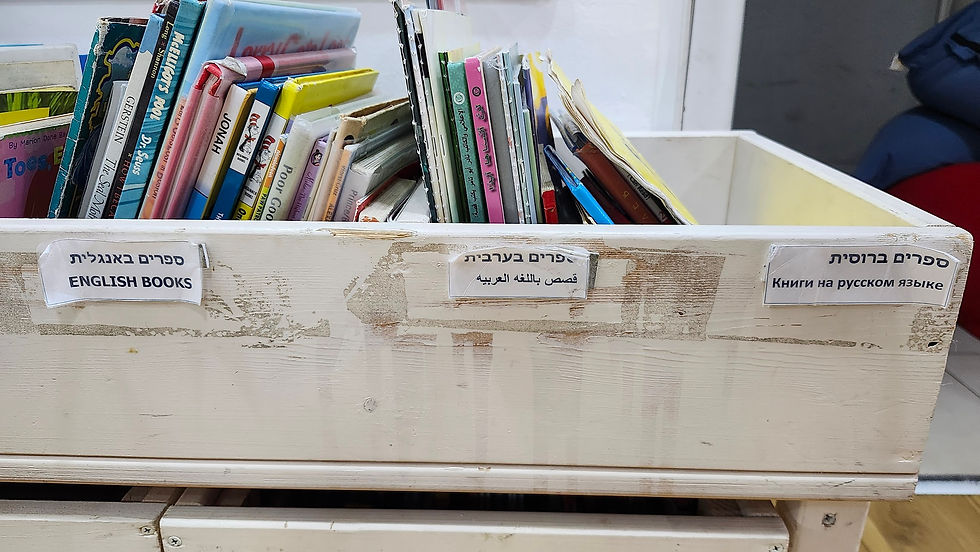
This is not an isolated incident. In the office, while the dominant language is Hebrew, at least one staff member each speaks Arabic and Russian, respectively. The children's bookshelf is sorted by language: Hebrew, English, Arabic, and Russian (with at least one book in Ukrainian, as discovered by a Russian-speaking mother recently). The different languages spoken are valorized whenever possible, such as the above example. Other examples include when Keren asked for translations of “Elephant” (Pil in Hebrew) in each language spoken by the parents in the room, including Portuguese, and when, during a lesson focused on a Russian children's story translated into Hebrew, Keren invited a Russian mother to retell the story in her mother tongue.
On some level, this linguistic diversity can be felt in all of Haifa. Some neighborhoods are riddled with shop signs in Russian, and one can hear Arabic, Amharic, Hebrew, and Thai all on the same Metronit ride from Hadar to Kiryat Haim. At the elementary school where I teach English for the Yahel fellowship, I have even heard parents speak Korean to their children.
However, the simple presence of linguistic diversity does not make its embrace a given. It takes effort to nurture this diversity and encourage those who speak different languages to interact with each other—not to assimilate or flatten, but to strengthen the pluralistic community that Haifa has the potential to embody. Language is both communication and culture. Each new learned language opens up a new world of communication with other human beings, while one’s own mother tongue usually retains a quality of home which is painful to lose by way of assimilation. It would be a great tragedy to choose communication over culture by forcing linguistic homogeny, but also a tragedy to choose culture over communication by siloing in one’s own language community.

Therefore, when linguistic diversity is celebrated, a beautiful middle ground is laid: every mother tongue can have its space to breathe, while individuals of all walks of life are encouraged to learn from each other, promoting richer and more exciting avenues of communication. Hebrew speakers should learn Arabic and vice versa; Russians should learn Hebrew, while native Israelis (both Arabic- and Hebrew-speaking) should make efforts towards Russian vocabulary as well. Everyone can try a little bit of Amharic or Korean or Thai or Spanish, even just to say please and thank you. It goes a long way.
Horim BaMercaz does a great job of this, from what I have seen. More could always be done, but it is a powerful start. Then there's Yad BeYad, a network of private bilingual Hebrew-Arabic preschools working to build relationships between families and make both languages feel like “home” to all the children. They even prompted the children to say Good Morning in Russian during our visit. And the students at the elementary school where I volunteer, in Kiryat Haim, have Arabic class as well as English, although it is unclear how much they will retain.

All this is strangely fresh for me, even as a New Yorker. It inspires me to make an effort. I teach voice lessons to teens in English, and one of my students often sings Russian songs; while I don’t understand a word, I’ve become familiar with the sound. As an avid language learner, I have begun attempting small words at Russian and Arab establishments, such as “hello” and “thank you.” I could have done this in New York, where I’m used to advertisements in Spanish or Haitian Creole or Chinese as a simple fact of life, and yet I never thought to try it. But here it feels different, more intentional; here, language carries a political charge: Hebrew is associated with the Jewish population, Arabic is associated with the Arab population (even though many Israeli Jews come from Arabic-speaking backgrounds), and newer diaspora languages are perhaps considered a sort of extra flavor rather than a crucial piece of the Israeli puzzle. It is often a political statement here for a Jew to learn Arabic, signaling one of a number of possible reasons for doing so. But we could all learn a little bit of everything and make this country a little more interconnected.
Hebrew is, of course, the central language of Am Yisrael (the Jewish people), and I stand by its official status. But if I have learned anything from my time in Haifa, it’s that there is room both to acknowledge this fact and to nurture the rich linguistic tapestry in Israel. What could be more beautiful than a country of immigrants and a returning diaspora learning to understand each other and unify, not under a banner of homogeny, but under a celebration of every fascinating particularity that our diasporic history—and our non-Jewish neighbors—have to offer?

Horim BaMercaz, my students of numerous backgrounds, my Russian-speaking voice student, the Arab Christian man who runs my favorite café who joked “so am I” when he learned I was trying to learn Arabic, and the Yad B’Yad preschools are all examples of Haifa’s potential—and in turn, Israel’s potential—to nurture linguistic diversity and usher in a new era for Israel and for the Jewish people. I look forward to watching it unfold.
Apendix:


A good reference layout should let readers scan headings, pick a category, and drill down without confusion. The page at this starting point follows that approach, offering a clear entry into a broad collection of linked articles.